
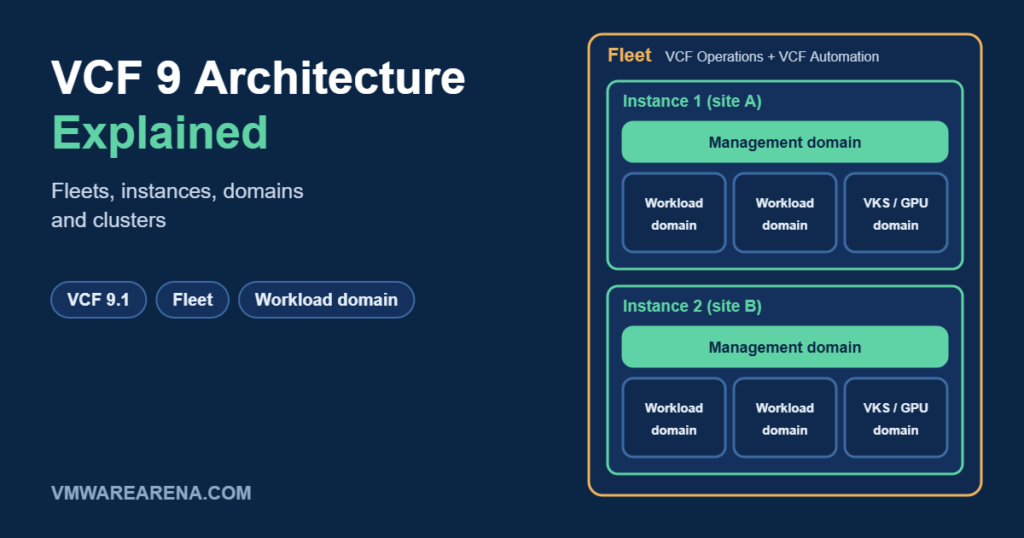
The first time I sat through a VCF 9 design workshop, half the room spent the first hour asking the same question in different ways: “So what exactly is a fleet, and how is it different from an instance?” If you came from VCF 4 or 5, the old mental model of “one SDDC Manager, a management domain and some workload domains” doesn’t quite fit any more.
Getting these terms right matters, because they decide where your management components run, what fails together, and how you scale. Here’s how I explain the VCF 9 hierarchy, from the top down.
The Hierarchy at a Glance
| Level | What it is | Managed by |
|---|---|---|
| Private cloud | Everything you run on VCF; can contain one or more fleets | — |
| Fleet | One or more VCF instances under a single set of fleet management components | One VCF Operations + one VCF Automation |
| Instance | A management domain plus its workload domains | One SDDC Manager per instance |
| Domain | Management domain or VI workload domain, each with its own vCenter | vCenter (+ NSX) |
| Cluster | vSphere clusters inside a domain | vCenter |
Fleet
The fleet is the new top-level unit in VCF 9. It’s all the infrastructure managed by one VCF Operations and one VCF Automation: lifecycle, licensing, certificates, passwords, monitoring and self-service for everything underneath. A fleet can span several locations, so a company with two data centres can run both as one fleet with one pane of glass.
In VCF 9.1 the fleet-level components (fleet lifecycle management, log management, the license server) run on the first VCF instance. That first instance carries more load than the others, so size its management domain accordingly.
Instance
A VCF instance is roughly what we used to call “a VCF deployment”. It has exactly one management domain (vCenter, NSX Manager, ESX hosts, principal storage, SDDC Manager and a VCF Operations collector) and can have any number of VI workload domains. Typically you’d build one instance per site or per region.
Domains
- Management domain: runs the infrastructure services only. Keep tenant workloads out of it.
- VI workload domains: where applications run. Each has its own vCenter, so it’s a separate lifecycle, security and failure boundary. You can share one NSX instance across workload domains or give a domain its own.
Workload domains are your main isolation tool. Typical splits I use: production vs non-production, a domain per business unit or tenant, a dedicated domain for Kubernetes (VKS) or GPU workloads, and a separate domain for anything with special compliance needs.
What Moved from SDDC Manager to VCF Operations
If you’re coming from VCF 5.2, this is where muscle memory will trip you up. Many day-2 tasks moved:
- New workload domains are deployed from VCF Operations, not SDDC Manager.
- Certificate authority setup, certificates and passwords live under Fleet Management in VCF Operations.
- VCF Operations is the license manager for the whole stack. (See my VCF 9 licensing post.)
- Cluster creation and expansion are done from vCenter.
- Existing vSphere 8.0 U3 environments can be imported into VCF 9.1 as workload domains through VCF Operations, without rebuilding them.
How I’d Lay Out a Typical Design
- Start with one fleet. Multiple fleets mean multiple VCF Operations and Automation stacks. Only split fleets if you need hard separation, for example a sovereign or regulated environment that must not share management with the rest of the company.
- One instance per site. Each data centre gets its own management domain and SDDC Manager, all under the same fleet.
- Workload domains by isolation need, not by habit. Each domain adds a vCenter (and maybe NSX) to run and patch, so don’t create them just for tidiness.
- Size the first instance’s management domain generously, since it hosts the fleet-level components.
- Plan networking early. Decide on NSX sharing and VPC design before the first workload domain. My VPC and Transit Gateway post covers the choices.
My Take
The new terms sound like marketing at first, but they map to real boundaries: the fleet is your management boundary, the instance is your site boundary, and the workload domain is your isolation and lifecycle boundary. Get those three right in the first design session, and everything else (networking, licensing, operations) falls into place much more easily.
I hope this is informative for you. Thanks for reading! Be social and share it on social media if you feel worth sharing it.