
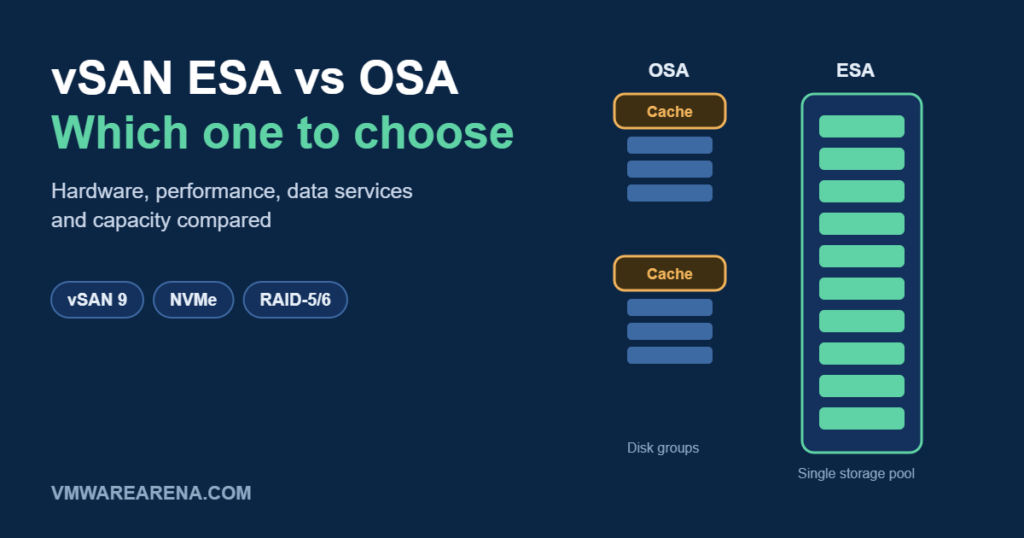
Since vSAN 8, there are two ways to build a vSAN cluster: the Original Storage Architecture (OSA) that we’ve used for years, and the newer Express Storage Architecture (ESA). They share the same name and the same vCenter screens, but under the hood they work very differently. In this post, I’ll walk through the key differences and help you decide which one to use for your next cluster.
How OSA Works
OSA organises storage into disk groups. Each disk group has one cache device and up to seven capacity devices, and each host can have up to five disk groups. The cache tier absorbs writes (and reads, in hybrid configurations), then destages data to the capacity tier.
- The cache device adds performance, not capacity.
- If the cache device fails, the whole disk group goes offline.
- Works with SAS, SATA and NVMe devices, in hybrid or all-flash configurations.
- Deduplication and compression are enabled per cluster, and only on all-flash.
How ESA Works
ESA drops disk groups entirely. Every NVMe device in a host goes into a single storage pool, and every device contributes to both performance and capacity. ESA was designed for modern, high-performance NVMe TLC devices, and its log-structured file system writes data in a way that makes erasure coding fast.
- No cache tier: all devices count towards capacity.
- A single device failure only affects that device, not a whole disk group.
- Requires ESA-certified NVMe devices and ESA ReadyNodes (or certified equivalents).
- Compression is on by default and can be controlled per storage policy.
- RAID-5 and RAID-6 perform as well as RAID-1, so you no longer trade capacity for speed.
Side-by-Side Comparison
| Feature | vSAN OSA | vSAN ESA |
|---|---|---|
| Storage layout | Disk groups (cache + capacity) | Single storage pool |
| Device types | SAS, SATA, NVMe (hybrid or all-flash) | Certified NVMe only |
| Cache tier | Yes, adds no capacity | No; every device adds capacity |
| Device failure impact | Cache failure takes out the disk group | Only the failed device |
| RAID-5 layout | 3+1, needs 4 hosts | Adaptive: 2+1 on 3–5 hosts, 4+1 on 6+ hosts |
| RAID-5/6 performance | Lower than RAID-1 | Comparable to RAID-1 |
| Data reduction | Dedup + compression, per cluster, all-flash only | Compression by default, controlled per policy |
| Snapshots | Traditional vSAN snapshots | Native, scalable snapshots built into the file system |
| Networking | 10 GbE minimum for all-flash | 25 GbE or faster recommended |
Capacity: Why ESA Usually Wins
Because ESA has no cache tier and makes RAID-5/6 practical for every workload, the same number of drives usually gives you much more usable space. On a six-host ESA cluster, switching from RAID-1 to RAID-5 (4+1) can give you around 60% more usable capacity, with no performance penalty. You can model your own cluster with the free vSAN Capacity Calculator.
Which One Should You Choose?
- New clusters with new hardware: choose ESA. It’s where VMware is investing, it’s simpler to operate, and it gives better performance and capacity efficiency.
- Existing OSA clusters with years of hardware life left: keep OSA and plan ESA for the next hardware refresh. You can’t convert a cluster in place; moving to ESA means building a new ESA cluster and migrating VMs with vMotion.
- Hardware that isn’t ESA-certified (SAS/SATA SSDs, older servers): OSA is your only option.
- Edge and small sites: ESA works well for 2-node and small clusters, but check the minimum hardware profiles for ESA ReadyNodes first.
Before You Buy
- Check every NVMe device against the Broadcom Compatibility Guide for vSAN ESA.
- Plan 25 GbE (or faster) networking; ESA can push far more traffic than OSA.
- Size with your real used capacity and growth, and remember the host rebuild reserve.
ESA is a big step forward for vSAN, and for most new deployments it’s the right default. If you have questions about your own design, drop them in the comments.