
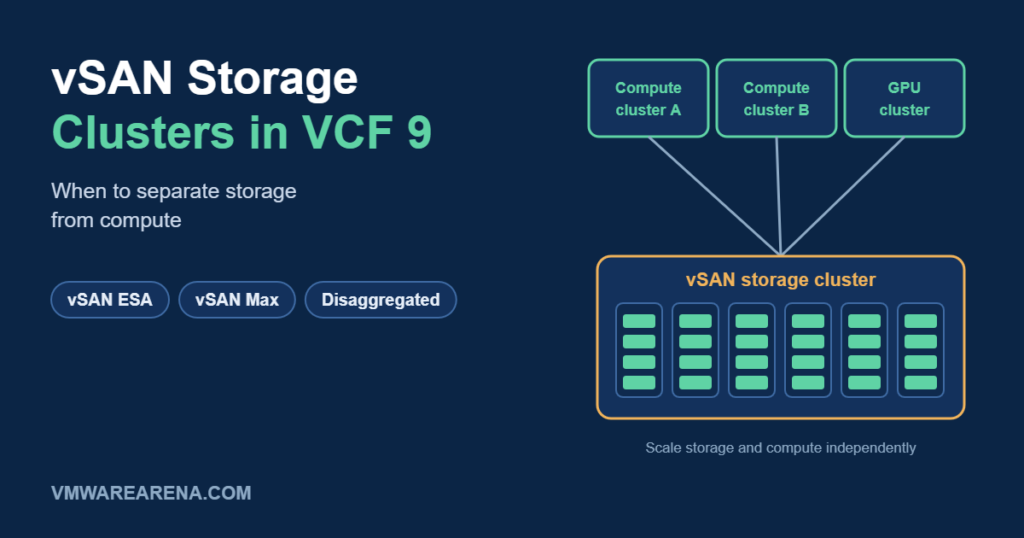
For years the vSAN conversation was simple: storage lives inside the same hosts that run your VMs. That’s hyperconverged (HCI), and for most clusters it’s still the right answer. But I keep running into the same situation in real projects: one cluster needs far more capacity than compute, or the database team wants its own storage tier, or the customer is retiring an old SAN and wants something that behaves like one without buying another array.
That’s exactly what vSAN storage clusters are for. You may know them by their old name, vSAN Max. In VCF 9 they’re a mature, first-class option, and every VCF architect should understand when to use them.
What Is a vSAN Storage Cluster?
A vSAN storage cluster is a cluster of hosts that only provides storage. It runs vSAN ESA and presents its datastore to one or more separate vSphere clusters, which mount it remotely and run the VMs. Storage and compute scale independently.
| vSAN HCI (aggregated) | vSAN storage cluster (disaggregated) | |
|---|---|---|
| Where VMs run | Same hosts as the storage | Separate vSphere (compute) clusters |
| Scaling | Add hosts = add compute + storage together | Add storage hosts or compute hosts independently |
| Architecture | ESA or OSA | ESA only |
| Who consumes it | The cluster itself | One or many vSphere clusters |
| Typical fit | Balanced workloads, most clusters | Storage-heavy workloads, SAN replacement, shared storage tier |
When I’d Choose a Storage Cluster
- Capacity grows much faster than compute. File servers, archives, backup repositories, large databases. With HCI you end up buying CPU and memory you don’t need just to get more drives.
- You’re replacing a traditional SAN. A storage cluster gives you central shared storage for several compute clusters, managed in vCenter, using standard servers instead of a proprietary array.
- Compute clusters with special hardware. GPU hosts or high-memory hosts often don’t have drive bays to spare. Let them mount storage from a dedicated cluster.
- Different lifecycles. Storage hosts often live 5–7 years; compute is refreshed faster. Separating them means you don’t have to replace drives every time you refresh CPUs.
And when I wouldn’t: small environments of 3–8 hosts with a balanced workload. HCI is simpler, cheaper and has fewer moving parts. Don’t disaggregate just because you can.
What VCF 9 Added
- Network traffic separation. You can now put the traffic between compute hosts and the storage cluster on its own VMkernel network, tagged “vSAN storage cluster client”, separate from the internal vSAN traffic between storage hosts. That’s better for both performance and security isolation.
- Stretched topologies. Compute and storage clusters can both be stretched across two sites, behaving like a stretched vSAN HCI cluster. That’s a metro-storage design without the cost and complexity of array replication.
- Global deduplication (9.1). Storage clusters are supported with vSAN ESA global dedup, which makes them even more attractive as a capacity tier. See my post on global dedup.
Design Points I Check First
- Network, network, network. All VM I/O now crosses the network between clusters. Plan 25 GbE at a minimum and 100 GbE for busy environments, with redundant top-of-rack switches. This is where most disaggregated designs succeed or fail.
- Storage cluster size. Use at least 6 storage hosts if you want RAID-6 (FTT=2) for a shared tier. Losing a storage cluster affects every compute cluster that mounts it, so resilience matters more than in a single HCI cluster.
- Failure domains. Spread storage hosts across racks and use fault domains if a rack can fail as a unit.
- Capacity reserves. The same rules apply as for HCI: operations reserve and host rebuild reserve. My vSAN Capacity Calculator works for storage clusters too, since the RAID and reserve maths is identical.
- Only VCF-created clusters. Clusters built outside VCF can’t mount a VCF-created storage cluster’s datastore, and the reverse also applies. Plan your cluster layout inside VCF from the start.
My Take
For most VCF customers, vSAN HCI remains the default, and that’s fine. But once you have a mix of storage-heavy workloads, GPU or high-memory hosts, or a SAN reaching end of life, a vSAN storage cluster is worth a serious look. It gives you shared storage you manage from vCenter on standard servers, and lets compute and storage grow at their own pace. Just don’t skimp on the network.
I hope this is informative for you. Thanks for reading! Be social and share it on social media if you feel worth sharing it.